

Are your payments made to the IRS electronic? What Taxpayers should know!
On March 25, 2025, the President signed Executive Order 14247, “Modernizing Payments To and From America’s Bank Account.” The order directs the federal government to modernize how it sends and receives payments with a goal of reducing paper checks, lowering fraud risk, improving processing efficiency, and increasing payment security.

What This Means for Taxpayers
For taxpayers, the important takeaway is simple: payments to and from the federal government are moving increasingly (…and I mean increasingly) toward electronic methods. This includes federal tax refunds, balances due, estimated tax payments (in which the 2nd quarter estimated tax payment is due on June 15, 2026), penalties, fees, and other payments made to the Department of the Treasury. The IRS has stated that the Executive Order applies to both ongoing payments, such as refunds, and income payments, such as tax payments.
Beginning September 30, 2025, the Treasury and IRS began phasing out paper refund checks to the extent permitted by law. For payments made to the IRS, checks and money orders are still being accepted for now; however, the IRS has made clear that it strongly encourages taxpayers to use existing electronic payment options and that the government will continue reducing reliance on paper remittances over time.
Electronic payments offer several practical advantages. They are generally faster, more secure, easier to track, and less likely to be lost, stolen, altered, or delayed than mailed checks. The Executive Order specifically notes that Treasury checks have historically been far more likely to be reported lost, stolen, returned undeliverable, or altered than electronic funds transfers.
Taxpayers can currently make IRS payments electronically through several options, including IRS Direct Pay, an IRS Online Account, EFTPS, electronic funds withdrawal when e-filing, same-day wire, debit card, credit card, or digital wallet. The IRS payment page specifically allows taxpayers to pay balances due, estimated tax payments, and payment plan amounts electronically.
Our Recommendation
In light of this federal transition, we recommend that taxpayers make all federal tax payments electronically whenever possible, including quarterly estimated tax payments. Of course, there could be exceptions, but consult with us to determine what the exception might be, and we can help! Electronic payment reduces mailing risk, provides better confirmation records, and aligns with the direction of current Treasury and IRS policy.
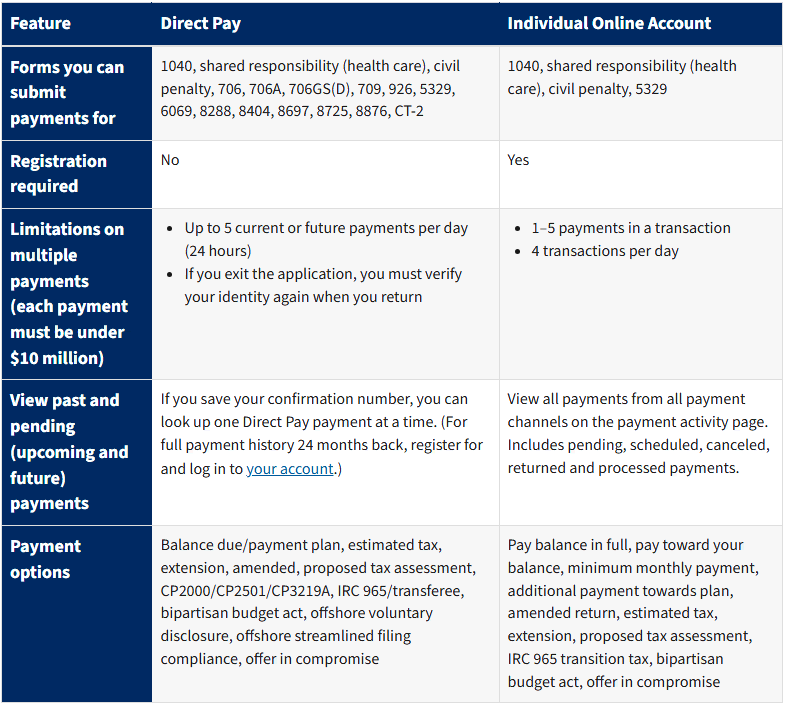
Individual taxpayers who still pay by check should begin transitioning now by either choosing IRS Direct Pay (which does not require a login) (Direct Pay with bank account | Internal Revenue Service) or setting up a log in for an IRS Online Account (Your account | Internal Revenue Service). Businesses, trusts, and individuals who make recurring or estimated payments should especially consider using EFTPS or another IRS-approved electronic method to schedule payments in advance and maintain reliable payment records. The differences between the Direct Pay and Individual Online Account are highlighted in the below table: (Source: Direct Pay help | Internal Revenue Service).
Estimated Tax Reminder – June 15 Deadline Is Almost Here
Taxpayers who make quarterly estimated tax payments should be aware that the second 2026 estimated tax payment is due June 15, 2026. Because this deadline is quickly approaching, now is the time to review whether an estimated payment is needed and to confirm the amount, tax year, and payment method before the due date.
This deadline is especially relevant for taxpayers with income that is not fully covered by withholding, such as business income, self-employment income, rental income, investment income, retirement income, or significant capital gains. The IRS may assess an underpayment penalty if enough tax is not paid throughout the year, even if the taxpayer ultimately files on time or is due a refund when the return is filed.
The June 15 deadline is also a practical reason to begin transitioning away from paper checks. Instead of mailing a voucher and check, taxpayers can make their payment electronically and receive a confirmation record. For individual taxpayers, IRS Direct Pay is often one of the simplest options. A taxpayer can visit IRS Direct Pay, choose “Estimated Tax” as the reason for payment, input the appropriate tax year, verify identity using prior-year return information, enter bank account information, review the details, and submit or schedule the payment. The whole process is generally straightforward, and unlike mailing a check, it does not depend on postal delivery or manual IRS processing.
This is a good opportunity to put the government’s electronic payment transition mandate into practice. Rather than mailing a check and hoping it arrives, hoping it is processed correctly, and hoping it is applied to the right tax year, taxpayers (like you) can and should make their second estimated tax payment electronically and retain an immediate confirmation record. As always, make sure to keep those confirmation numbers, payment dates, amounts, and the tax year or tax period applied. A payment is only helpful if it lands in the right IRS bucket, and we all know the IRS has plenty of buckets.